4-Piece vs 5-Piece Drum Sets: A Complete Comparison
A 4-piece drum set has one rack tom and a 5-piece adds a third tom: here is how that changes sound, space, setup and cost, and which one to buy.
PercussionDream is reader-supported. When you buy through links on this page we may earn an affiliate commission, at no extra cost to you. How this works
Shop for a drum set and you will see the same two labels again and again: 4-piece and 5-piece. The difference between them is one drum. That sounds small, but that one drum changes how the kit is laid out, how much room it needs, and how it feels to play.
This guide explains what the numbers mean, which drums are in each kit, how the sizes compare, and which one makes more sense for you. It is written for beginners and parents, so you do not need any drum knowledge to follow along.
4-piece vs 5-piece at a glance
If you only read one part of this guide, make it this table. The details behind each row come later.
| Feature | 4-piece | 5-piece |
|---|---|---|
| Drums | Bass drum, snare, one rack tom, one floor tom | Bass drum, snare, two rack toms and one floor tom, or one rack tom and two floor toms |
| Nickname | One up, one down | Two up, one down, or one up, two down |
| Number of toms | Two | Three |
| Ride cymbal position | Low and close, over the bass drum | Higher or further to the right, to clear the second tom |
| Floor space | A little less | A little more |
| Setting up and tuning | Quicker | One more drum to place, tune and carry |
| Often linked with | Jazz, classic rock, indie, small stages | Rock, pop, metal, fusion, gospel |
| Complete beginner kits | Less common | The usual format |
What does “piece” mean on a drum set?
On an acoustic drum set, a “piece” is a drum. You count the bass drum, the snare drum and the toms. That is all.
These things are not counted:
- Cymbals, including the hi-hat
- Stands and pedals
- The seat, which drummers call a throne
So a kit with five drums and three cymbals is still a 5-piece. A kit with four drums and six cymbals is still a 4-piece.
One thing to watch: electronic kits are often counted in a different way. Their makers tend to count the cymbal pads too. One entry-level electronic kit we checked is sold as an “8-piece” because it has five drum pads and three cymbal pads. In acoustic terms, that same layout would be called a 5-piece.
What is a 4-piece drum kit?
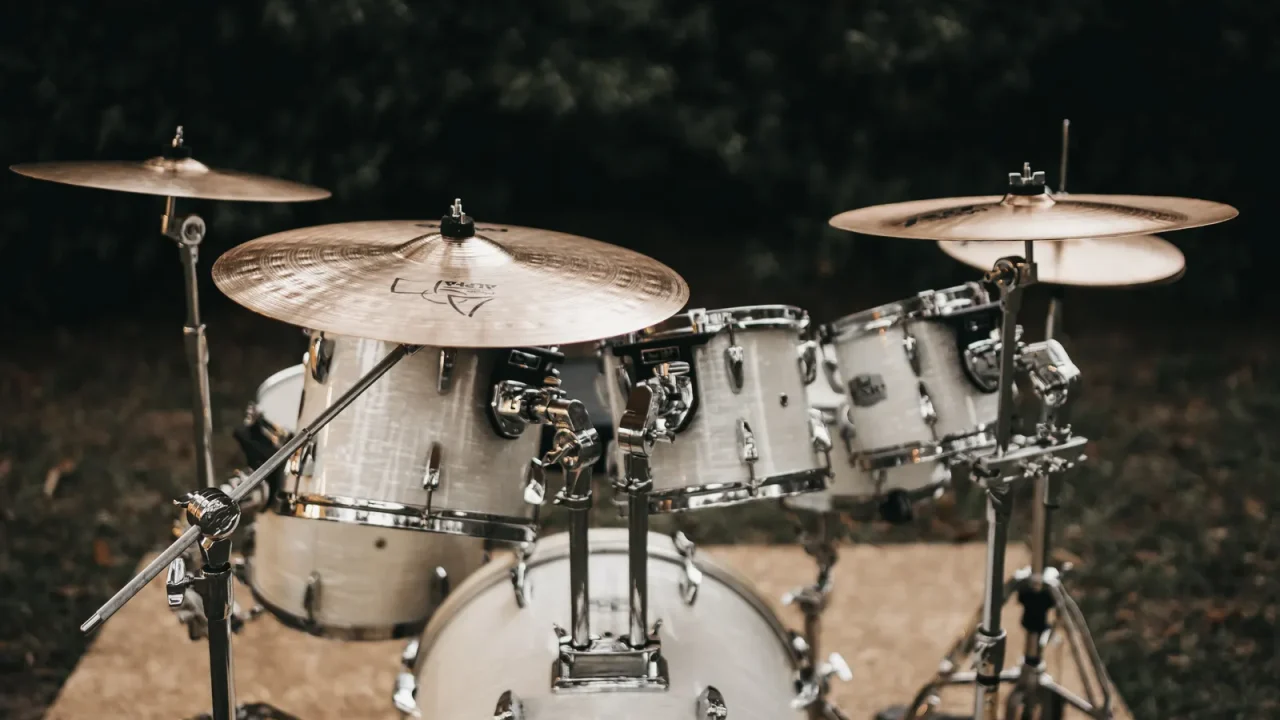
A 4-piece kit has four drums:
- Bass drum. The big drum on the floor, played with a foot pedal. It is also called the kick.
- Snare drum. The crisp, sharp drum that sits between your knees.
- Rack tom. One tom mounted above the bass drum. This is the “one up”.
- Floor tom. A deeper tom that stands on its own legs to your right. This is the “one down”.
Because there is only one tom on top of the bass drum, there is a gap beside it. Most players put the ride cymbal in that gap. It ends up low, close and easy to reach, which is a big part of why people love this layout.
The 4-piece is the classic setup of jazz and early rock and roll. Ringo Starr and Charlie Watts both spent most of their careers behind four-piece kits, which tells you how much music you can make with two toms.
What is a 5-piece drum kit?
A 5-piece kit has the same four drums plus one more tom. On the most common layout, the five drums are called:
- Bass drum (kick)
- Snare drum
- High tom, the smaller rack tom, on the left for a right-handed player
- Mid tom, the larger rack tom, on the right
- Floor tom, also called the low tom
That layout is known as two up, one down. It is what most people picture when they think of a drum set, and it is what most complete beginner kits use.
There is a second kind of 5-piece, called one up, two down. It keeps a single rack tom and adds a second, larger floor tom instead. You get three toms, but the top of the bass drum stays as open as it is on a 4-piece. Rock drummers often choose this layout.
Typical drum sizes in 4-piece and 5-piece kits
The number of drums is only half the story. The size of the drums changes the sound and the space just as much. Drum sizes are given in inches, and the number that matters most is the diameter, the distance across the head.
The sizes below come from current listings for popular kits. They show the common patterns. Other makers use slightly different sizes.
| Layout | Pieces | Bass drum | Rack toms | Floor toms | Snare |
|---|---|---|---|---|---|
| Compact | 4 | 16 in | 10 in | 13 in | 13 in |
| Jazz | 4 | 18 in | 10 in | 14 in | 13 in |
| Fusion | 5 | 20 in | 10 in and 12 in | 14 in | 14 in |
| Standard | 5 | 22 in | 10 in and 12 in | 16 in | 14 in |
| Rock (one up, two down) | 5 | 22 in | 12 in | 14 in and 16 in | 14 in |
A simple rule helps here. Smaller drums sound higher and take up less room. Bigger drums sound deeper and louder. A 5-piece in fusion sizes can take up about as much floor as a 4-piece in rock sizes. So do not judge a kit by the piece count alone. Check the bass drum size too.
The real differences
Sound and fills
Toms are mostly used for fills, the short runs around the kit that link one part of a song to the next. With three toms you can roll down three notes: high, middle, low. With two toms you have two notes, so you lean more on the snare and on rhythm to make a fill interesting.
For the main beat, there is no difference at all. Grooves are played on the bass drum, snare and hi-hat, and both kits have those.
Comfort and reach
This is the difference players notice most. On a 4-piece, the ride cymbal sits right where a second tom would be. Your right arm barely has to move.
On a two-up 5-piece, the second tom takes that spot. The ride has to go higher or further to the right. Tall adults will not mind. Children and shorter players sometimes find the ride a stretch, and two toms on top of a 22-inch bass drum can sit quite high.
A one-up, two-down 5-piece is the middle path. It keeps the easy ride position and still gives you a third tom.
Space
A 5-piece is bigger, but not by as much as you might think. The cymbal stands, the hi-hat and the throne take up floor space on both kits. As a rough guide, many players allow a square of floor about five to six feet on each side for a full-size 5-piece with its throne. A 4-piece saves a little width, not half the room.
If space is tight, measure before you buy. Our Setup Visualizer lets you drag drums and cymbals onto a floor plan to see what fits.
Carrying and setting up
One more drum means one more thing to carry, one more case, and a few more minutes at each end of a rehearsal. If you plan to move your kit often, that adds up. Players who gig in small venues often choose a 4-piece for exactly this reason.
Tuning and upkeep
Every tom has two heads, top and bottom. A third tom means two more heads to tune and, in time, to replace. It is not hard, but it is extra work. Our Maintenance Tracker can remind you when heads are due.
Cost
Within the same model range, a 5-piece usually costs more than a 4-piece, because there is more wood and metal in the box. Across different ranges, it gets muddier. Most complete beginner bundles are 5-piece, so a starter 5-piece with everything included can cost less than a 4-piece set of better drums that comes with no cymbals or stands. Always compare what is in the box, not only the number of drums.
What changes around the kit
| What changes | 4-piece | 5-piece |
|---|---|---|
| Toms to tune | Two toms, four heads | Three toms, six heads |
| Tom mounting | A single tom holder | A double tom holder, or legs for a second floor tom |
| Ride cymbal | Low and close | Higher or further right on a two-up kit |
| Spare room on the bass drum | Space for a ride, cowbell or other extras | Mostly taken up by the two toms |
| Cases or bags | Four drums to pack | Five drums to pack |
| Recording | One fewer microphone | One more tom to mic |
Cymbals and hardware: check what is in the box
Since cymbals and stands are not part of the piece count, two “5-piece” kits can be very different purchases. You will see two main kinds of package.
- Complete kit. The drums, the stands, a bass drum pedal, a throne and a starter set of cymbals. Many beginner kits are sold this way. You can play it the day it arrives.
- Shell pack. The drums only. No cymbals, no stands, no pedal and no throne. Some shell packs do not even include a snare drum. These are aimed at players who already own the rest.
There are in-between packages too. One 4-piece kit we checked includes its stands and pedal but no cymbals. Read the “what is included” part of any listing slowly. If you are searching for a 4-piece drum set with cymbals, be aware that many 4-piece kits are sold without them.
Which is better for beginners?
For most beginners, a 5-piece complete kit is the easier choice. There are three reasons:
- Most complete starter kits are 5-piece, so you have more to choose from.
- Many lesson books, videos and teaching studios assume a 5-piece layout.
- You can remove a tom and play it as a 4-piece any time you like. You cannot do the reverse without buying another drum.
A 4-piece is the better pick if your room is small, if the player is small, or if you simply like a tidy, simple setup. Nothing about a 4-piece will hold a beginner back. Timing, technique and coordination are learned on the snare, bass drum and hi-hat.
For young children, neither is right. A full-size kit of any piece count is too big. Look at junior kits instead. Our guide to the best beginner drum kits covers full-size and junior options.
Which suits your music?
These are habits, not rules. Great players break them all the time.
- Jazz: usually a 4-piece in small sizes. The ride cymbal does most of the work, so it needs to be close.
- Classic rock, indie and punk: a 4-piece, or a one-up, two-down 5-piece.
- Pop, modern rock and worship: a 5-piece, for the wider choice of fills.
- Metal, fusion and gospel: a 5-piece or larger, often with extra toms and cymbals.
- Not sure yet: a 5-piece, because it can cover everything on this list.
Can you turn a 5-piece into a 4-piece?
Yes, and it takes about a minute. Take off one rack tom, slide the ride cymbal into the gap, and you have a 4-piece. Keep the spare tom somewhere safe. Many drummers switch back and forth depending on the song or the size of the stage.
Going the other way is harder. To turn a 4-piece into a 5-piece you need to buy a matching tom and a way to mount it. Some makers sell add-on toms for their kits. Check that the same series and colour are still on sale before you count on this, because finishes are dropped over time.
How to set up a 4-piece or 5-piece kit
These steps are for a right-handed player. If you are left-handed, mirror everything.
- Start with the throne. Set the height so your thighs are about level or slope down slightly. Everything else is placed around where you sit.
- Place the bass drum. Put it on a rug so it does not creep forward, and set the pedal where your right foot rests naturally.
- Add the snare. It goes between your knees, a little above your thighs, so your sticks clear your legs.
- Add the hi-hat. It stands to the left of the snare, with its pedal under your left foot.
- Mount the rack tom or toms. Tilt them slightly towards you. On a 4-piece, the single tom sits just left of centre. On a 5-piece, the small tom goes on the left and the larger one on the right, close together.
- Stand the floor tom on your right. Set it at about the same height as the snare.
- Place the cymbals. The crash goes on the left, above the hi-hat and tom. On a 4-piece, the ride sits over the bass drum where a second tom would be. On a two-up 5-piece, it goes to the right of the second tom, above the floor tom.
- Sit down and test your reach. You should be able to hit every drum and cymbal without leaning or stretching. If you cannot, move the drum, not your body.
The Percussion Setup Generator gives you a printable checklist of everything a kit needs, which is handy on the day it arrives.
Common mistakes to avoid
- Counting cymbals as pieces. Only drums count on an acoustic kit.
- Buying a shell pack by accident. A low price on a “5-piece” may mean drums only. Check for cymbals, stands, a pedal and a throne.
- Thinking more drums make a better drummer. They do not. Clean timing on a small kit beats sloppy playing on a big one.
- Ignoring the bass drum size. A kit with an 18-inch or 20-inch bass drum sits lower and takes less room than one with a 22-inch.
- Buying a full-size kit for a small child. If they cannot reach the pedals and cymbals comfortably, they will not enjoy playing.
- Crowding the toms. If the ride cymbal ends up out of comfortable reach, take a tom off.
- Forgetting the extras. You will still need drumsticks, hearing protection and, on some kits, a throne.
Three kits that show the difference
Disclosure: the buttons below are affiliate links. If you buy through one of them, we may earn a commission at no extra cost to you.
Here is one compact 4-piece and two 5-piece kits, one in each layout. We chose them from their published specifications and from what a new player needs. We have not tested them ourselves. We checked each listing on 9 October 2026. Stock, colours and prices change, so check the listing before you decide.
Pearl Midtown 4-Piece Drum Set with Hardware (MT564)
Best for: Small rooms, small stages and players who want a simple one-up, one-down kit.
The small drum sizes keep the footprint down, and the stands and pedal are included, so you only need to add cymbals and a seat.
- 16 x 14 in bass drum with a riser
- 10 x 7 in tom, 13 x 12 in floor tom, 13 x 5.5 in snare
- 6-ply poplar shells
- Snare stand, hi-hat stand, boom cymbal stand and chain-drive pedal included
Keep in mind: Cymbals are not included, and the listing does not mention a throne. A 16-inch bass drum sounds tighter and less deep than a full-size one.
Affiliate link — we may earn a commission.
Pearl Roadshow 5-Piece Complete Drum Set, Fusion sizes (RS505C)
Best for: Beginners who want the standard 5-piece layout with everything in one box.
It is a complete kit in slightly smaller fusion sizes, which keeps the two rack toms lower and the whole kit a little more compact.
- 20 x 16 in bass drum, 14 x 5 in snare
- 10 x 7 in and 12 x 8 in rack toms, 14 x 14 in floor tom
- Cymbal, hi-hat and snare stands, bass drum pedal and throne included
- 16 in crash/ride and 14 in hi-hats, plus sticks and a stick bag
Keep in mind: One cymbal does the job of both crash and ride. The listing covers several sizes and colours, so check that “Fusion” is selected.
Affiliate link — we may earn a commission.
Pearl Roadshow 5-Piece Complete Drum Set, Rock sizes (RS525WFC)
Best for: Players who like the open feel of a 4-piece but want a third tom.
With one rack tom and two floor toms, the ride cymbal can stay low and close while you still get three tom notes for fills.
- 22 x 16 in bass drum, 14 x 6.5 in snare
- 12 x 9 in rack tom, 14 x 14 in and 16 x 16 in floor toms
- Cymbal, hi-hat and snare stands, bass drum pedal and throne included
- 16 in crash/ride and 14 in hi-hats, plus sticks and a stick bag
Keep in mind: These are bigger, louder drums that need more floor space. The listing covers several sizes and colours, so check that “Rock” is selected.
Affiliate link — we may earn a commission.
Want to compare more options? Our beginner drum kit guide goes deeper into what a complete kit includes, sizing and noise, and our snare drum guide covers the drum you will hit most.
Related reading: our guide to drums vs percussion and how they differ.
Frequently asked questions
Do cymbals count as pieces in a drum set?
No. On an acoustic drum set, only the drums are counted: the bass drum, the snare and the toms. Cymbals, stands, pedals and the throne are not part of the number.
What are the drums in a 5-piece kit called?
On the most common layout they are the bass drum, the snare drum, the high tom, the mid tom and the floor tom. The high and mid toms are also called rack toms because they are mounted above the bass drum.
Is a 4-piece drum set enough for a beginner?
Yes. Everything a beginner needs to learn, including timing, basic beats and simple fills, can be played on a 4-piece. The main reason beginners often end up with a 5-piece is that most complete starter kits are sold that way.
Is a 5-piece kit harder to play than a 4-piece?
Not really. The beats are the same. A 5-piece gives you one more drum to reach in fills, and the ride cymbal sits a little further away on a two-up layout. Most players adjust within a few sessions.
What are 3-piece, 6-piece and 7-piece drum sets?
The number always counts the drums. A 3-piece usually has a bass drum, a snare and one tom. A 6-piece or 7-piece adds more toms to the 5-piece layout, and sometimes a second bass drum or snare.
How are electronic drum kits counted?
Often differently. Many makers count the cymbal pads as well as the drum pads. An electronic kit with five drum pads and three cymbal pads may be sold as an 8-piece, even though the same layout in acoustic drums would be called a 5-piece.
Checklist before you buy
Run through these questions with the listing open in front of you.
- How many drums are in the box, and which ones?
- Is it a complete kit or a shell pack?
- Are cymbals, stands, a bass drum pedal and a throne included?
- What size is the bass drum: 16, 18, 20 or 22 inches?
- Is it two up, one down, or one up, two down?
- Have I measured the floor space, including room for the throne?
- Can the player reach the ride cymbal and the pedals comfortably?
- Have I set aside money for sticks and hearing protection?
The bottom line
A 4-piece and a 5-piece drum set are the same instrument with one tom of difference. The 4-piece is simpler, smaller and puts the ride cymbal in the perfect spot. The 5-piece gives you one more voice for fills and is the format most starter kits come in.
If you are buying your first kit and have the room, get a complete 5-piece and try it both ways. If space is tight, or you just like the clean look of one up, one down, a 4-piece will never hold you back. Either way, the beat lives in the same three places: bass drum, snare and hi-hat. To plan your practice once the kit is set up, try our Practice Time Calculator.