Cajon Drum Box: The Wooden Box Drum You Sit On, Explained
The wooden box drum you sit on is called a cajon: here is where it comes from, how one box makes bass and snare sounds, and how to play your first beat.
PercussionDream is reader-supported. When you buy through links on this page we may earn an affiliate commission, at no extra cost to you. How this works
You have probably seen one without knowing its name. A musician sits on a plain wooden box, slaps the front with their hands, and somehow it sounds like a small drum kit. That box is called a cajon, and it is one of the simplest and most useful percussion instruments there is.
This guide explains what the wooden box drum is, where it comes from, how it makes its sounds, and how to start playing one. It is written for complete beginners, so you do not need any musical background to follow along.
The cajon at a glance
| Question | Answer |
|---|---|
| What is it called? | Cajon, written cajón in Spanish. Also box drum or drum box |
| How do you say it? | ka-HON, with the stress on the second half |
| What is it? | A hollow wooden box with a thin front panel and a round hole in the back |
| How do you play it? | You sit on it and strike the front with your hands |
| Where is it from? | Peru |
| What family is it in? | Percussion |
| How big is it? | A full-size cajon is usually about 18 to 20 inches tall and around 12 inches wide and deep |
| What music uses it? | Afro-Peruvian music, flamenco, and acoustic pop, folk and worship music |
What is a cajon?
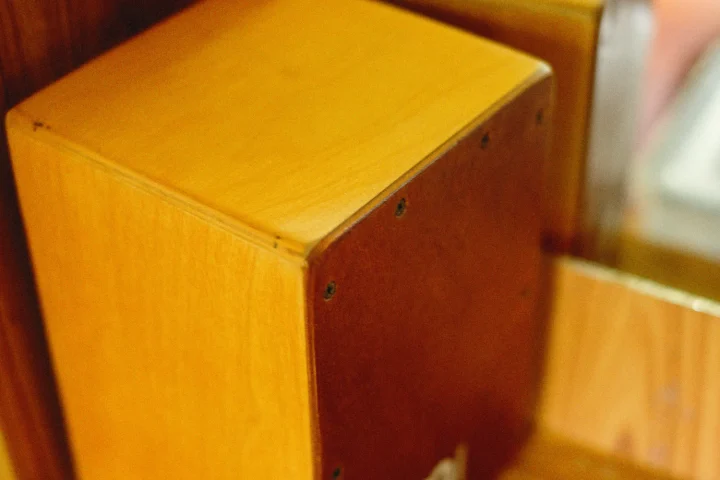
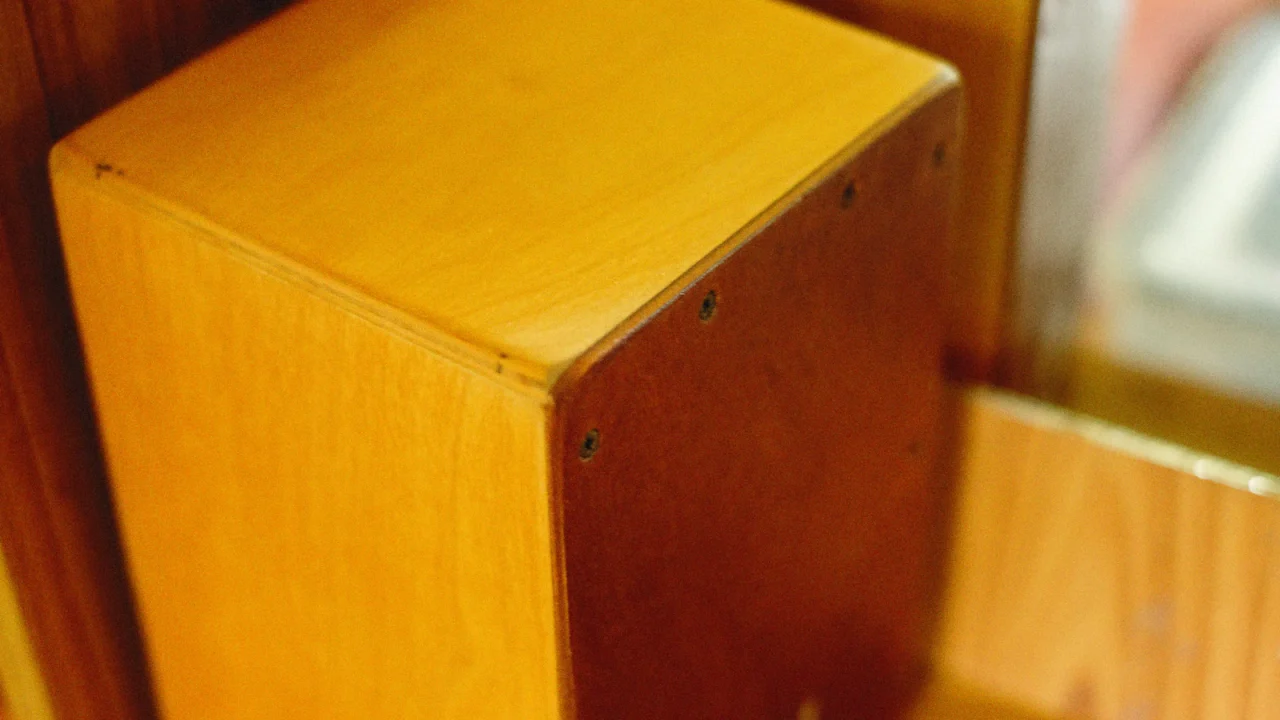
A cajon is a six-sided wooden box. Five sides are thick and stiff. The sixth, the front, is a thin sheet of plywood called the tapa. The tapa is the part you play. A round hole in the back, called the sound port, lets the air and the sound out.
That is the whole instrument. There are no skins, no stands and no pedals. You sit on the top, lean forward slightly, and play the tapa with your palms and fingers.
Most modern cajons have one extra feature inside: something that rattles against the back of the tapa. It is usually a set of thin metal wires, like those under a snare drum, or a few guitar strings. This gives the high sound its crisp buzz.
Where does the cajon come from?
The cajon comes from the coast of Peru. The usual account is that enslaved Africans there, who had been separated from their own drums, played rhythms on wooden boxes and shipping crates. Over time the box became an instrument in its own right and a central part of Afro-Peruvian music. In 2001 Peru officially declared the cajon part of the nation’s cultural heritage.
The cajon reached the rest of the world through flamenco. In the late 1970s the Spanish guitarist Paco de Lucía came across the instrument in Peru and brought one home, and it was soon adopted by flamenco groups. Later, players added snare wires and strings, and the cajon spread into pop, folk and acoustic music of every kind.
How one box makes two sounds
The trick of the cajon is that the same panel sounds different depending on where you hit it.
- The bass tone. Strike the middle of the tapa with a flat palm and let your hand bounce off. The whole panel moves, the air inside the box is pushed out through the hole, and you hear a low thump.
- The slap, or high tone. Strike near the top edge with your fingers. Only the top strip of the panel moves, and it rattles the wires or strings inside. You hear a sharp, bright crack.
Between those two there are softer taps with the fingertips, which fill in the gaps. Put the three together and you have the bones of a drum beat.
How a cajon stands in for a drum kit
| Drum kit part | What it does | On a cajon |
|---|---|---|
| Bass drum | The low thump on the main beats | Palm in the middle of the front panel |
| Snare drum | The sharp crack on the backbeat | Fingers near the top edge |
| Hi-hat | The steady ticking in between | Light fingertip taps near the top corners |
| Cymbals and extras | Accents and colour | Add-ons such as a shaker, foot tambourine or brushes |
This is why the cajon is so popular with acoustic bands. It gives a singer and a guitarist a real beat, at a volume that suits a cafe or a living room, and it fits in the boot of a small car.
Types of cajon
- Peruvian cajon. The original design, with nothing inside. The sound is dry, woody and open.
- Snare cajon. The most common type today. Snare wires behind the tapa give a crisp, kit-like backbeat.
- String cajon. Guitar-style strings sit against the tapa and give a finer, softer buzz. This is the classic flamenco sound.
- Cajon with a snare switch. A lever or knob lifts the wires away, so you can choose between the dry and the crisp sound.
- Bass cajon. A larger or specially built box with a deeper low note.
- Travel and lap cajons. Smaller, lighter designs. Some are played on the lap or between the knees. They are easy to carry and have less bass.
Our cajon buying guide compares these types in detail and explains what to look for in each.
How to sit and play your first beat
- Sit on the top, towards the back edge, with the tapa facing forward between your legs.
- Put your feet flat on the floor, a little wider than the box. Your thighs should be roughly level.
- Lean forward slightly from the hips, keeping your back long. Some players tilt the box back a little so the tapa is easier to reach.
- Play a bass note. Let a relaxed, flat hand drop onto the middle of the tapa and bounce off.
- Play a slap. Flick your fingers onto the top two or three inches of the tapa.
- Put them in order. Count “one, two, three, four”. Play bass on one and three, and a slap on two and four. That is a basic rock beat.
Start slowly and keep it even. A metronome helps from the first day, and our free Metronome Trainer runs in your browser.
Is the cajon easy to learn?
It is one of the easiest percussion instruments to begin on. There is nothing to set up or tune, and most people can play a simple beat within their first session. That makes it a good first instrument for adults and older children.
Playing it well takes longer. Clean, separate bass and slap sounds, steady time and a light touch all come with practice. A few minutes a day does more than one long session a week, and our Practice Time Calculator can turn that into a simple plan.
How loud is a cajon?
A cajon is much quieter than a drum kit, which is a large part of its appeal. It is not silent, though. The bass note carries through floors, and a hard slap is sharp at close range. In a flat, a thick rug underneath and a lighter touch help. Brushes or soft rods lower the volume further.
Other wooden box instruments people mix it up with
“Wooden box instrument” can describe several things. If the instrument you saw does not quite match a cajon, it may be one of these.
| Instrument | What it looks like | How it is played |
|---|---|---|
| Cajon | A box about the size of a small stool | You sit on it and play the front with your hands |
| Slit drum, also called a log drum or wooden tongue drum | A wooden box with tongues cut into the top | You strike the tongues with soft mallets, and each gives a different note |
| Kalimba, or thumb piano | A small wooden box or board with metal strips on top | You pluck the metal strips with your thumbs |
| Stomp box | A small, flat wooden box on the floor | A guitarist taps it with a foot to add a bass beat |
| Woodblock | A small, solid block with a slot cut in it | You hit it with a stick for a sharp “tock” |
Common mistakes to avoid
- Hitting too hard. It hurts, and it sounds worse. Let the hand bounce.
- Slouching. A rounded back gets sore quickly. Lean from the hips.
- Wearing rings or a watch. They mark the wood and can hurt your hands.
- Playing only in the middle. The cajon’s range comes from using the top edge and the corners as well.
- Buying a child-sized box for an adult. You need to sit with your feet flat and your thighs level.
- Practising without a pulse. The cajon is a timekeeping instrument. Use a click.
- Leaving it in the damp or the sun. It is made of wood, and the thin front panel can warp.
Two cajons to look at
Disclosure: the buttons below are affiliate links. If you buy through one of them, we may earn a commission at no extra cost to you.
These are two snare cajons from a long-established percussion maker. We chose them from their published specifications. We have not tested them ourselves. We checked each listing on 9 October 2026. Stock and prices change, so check the listing before you decide.
Meinl Percussion Jam Cajon
Best for: Trying the cajon at a low cost, and for smaller players.
The listing describes a Baltic birch box, made in Europe, with two fixed sets of snare wires for a crisp high tone.
- Baltic birch body
- Two fixed sets of steel snare wires
- Rear sound port
- Listed at 15 in tall and 10.25 in wide and deep
Keep in mind: At 15 inches it is lower than a full-size cajon, so taller adults may find it a low seat. The snares cannot be switched off.
Affiliate link — we may earn a commission.
Meinl Percussion Cafe Cajon with Bag
Best for: Adults who want a taller box and a bag for carrying it.
It is a larger Baltic birch cajon with the same two sets of snare wires, and the version we checked comes with a gig bag.
- Baltic birch body, listed as made in Europe
- Two fixed sets of steel snare wires
- Listed at 17.25 in tall and 12 in wide and deep
- Gig bag included in the “with bag” option
Keep in mind: The snares are fixed, so there is no dry, snare-off sound. Check that the “with bag” option is selected.
Affiliate link — we may earn a commission.
For a full comparison of cajon types, sizes and woods, see our cajon buying guide.
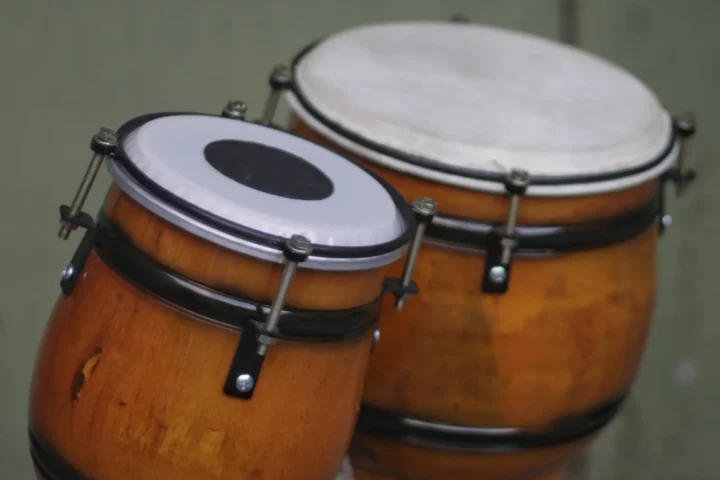
Related reading: our guides to bongo vs conga drums and drums vs percussion and how they differ.
Frequently asked questions
What is the wooden box drum called?
It is called a cajon, pronounced ka-HON. The name is Spanish for box or crate. It is also called a box drum or drum box.
What is the drum you sit on?
The drum you sit on is a cajon. The player sits on top of the wooden box and strikes the thin front panel with their hands.
Is a cajon a drum?
In everyday talk, yes, and it is often called a box drum. Strictly speaking it has no skin, so it belongs with the percussion instruments whose whole body makes the sound. It is played as a drum and does the job of one.
Where does the cajon come from?
The cajon comes from the coast of Peru, where it grew out of Afro-Peruvian music. It became known around the world after it was taken up by flamenco musicians in Spain in the late 1970s.
How does a cajon make a snare sound?
Most modern cajons have snare wires or guitar strings resting against the back of the front panel. When you strike near the top edge, the panel rattles against them and makes a crisp, buzzing crack.
Can a cajon replace a drum kit?
For quiet, acoustic music, often yes. Its bass and slap sounds cover the jobs of the bass drum and snare. It does not have the volume, the cymbals or the range of a full drum kit.
Checklist before you start
- Can I sit on it with my feet flat and my thighs level?
- Does it have snare wires, strings or neither?
- Do I want to be able to switch the snare sound off?
- Is a bag included for carrying it?
- Where will I play, and how much noise is acceptable?
- Have I taken off rings and my watch?
- Do I have a metronome to practise with?
The bottom line
The wooden box that drummers sit on is a cajon. It began as a humble crate in Peru, crossed into flamenco, and is now found wherever people play acoustic music together. Its appeal is simple: one box, two clear sounds, and nothing else to carry.
If you want an easy way into rhythm, it is hard to beat. Learn the bass note and the slap, put them into a steady pattern, and you are playing. When you are ready to choose one, our cajon buying guide takes you through the options, and the Instrument Match Quiz can tell you whether a cajon or another instrument suits your space.