Bongo vs Conga Drums: Key Differences, Similarities, and Which One to Choose
Bongos are small, bright and played on your lap; congas are tall, deep and need more room. Compare sound, technique and cost, and decide which to learn first.
PercussionDream is reader-supported. When you buy through links on this page we may earn an affiliate commission, at no extra cost to you. How this works
Bongos and congas get mixed up all the time. Both are Cuban hand drums, both show up in salsa bands, and even the names sound alike. But they are very different instruments. Bongos are a small, high-pitched pair that you hold between your knees. Congas are tall, deep-voiced drums that stand on the floor.
This guide explains how the two differ in size, sound, technique, cost and space, and then helps you decide which one makes sense for you. It is written for beginners, parents and curious players, so you do not need any music theory to follow along.
Bongo vs conga at a glance
If you only read one part of this guide, make it this table. The details behind each row come later.
| Feature | Bongos | Congas |
|---|---|---|
| What it is | Two small drums joined by a wooden bridge | Tall, barrel-shaped drums, each one separate |
| Typical head size | About 6.5 to 7 in and 7.5 to 8.5 in | About 10 to 12.5 in |
| Height | About 7 to 8 in | About 28 to 30 in |
| Sound | High, dry and crisp | Deep, warm and round, with a real bass note |
| Played with | Mostly the fingers | The whole hand: fingers, palm and heel |
| Playing position | Seated, held between the knees, or on a stand | Seated or standing, on the floor or on a stand |
| Usual setup | One pair | One to three drums |
| Core rhythm | Martillo | Tumbao |
| Portability | Easy; fits in a small bag | Bulky; each drum is carried on its own |
| Cost to start | Lower | Higher, especially once you add a stand |
| Learning curve | Quick to start | Slower start, with more to master |
What are bongos?
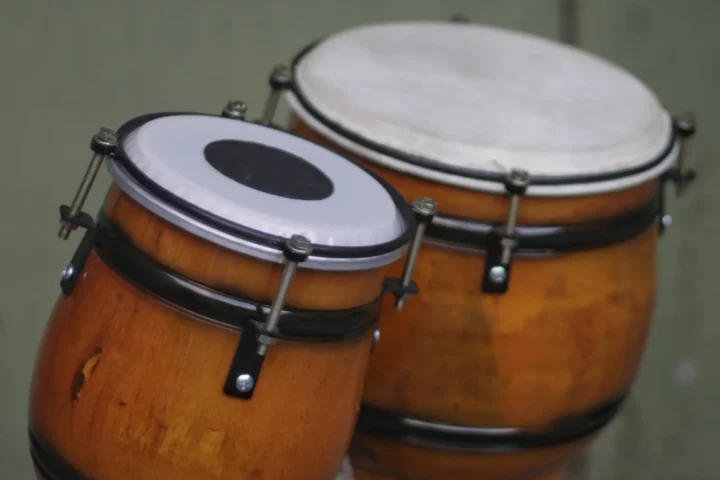
Bongos are a pair of small, open-bottomed drums joined side by side by a block of wood called the bridge. The two drums are different sizes, so they give you two pitches to play with.
- The smaller drum is the macho (Spanish for “male”). It is tuned high and tight.
- The larger drum is the hembra (“female”). It is tuned lower.
Bongos come from eastern Cuba, where they appeared in the late 1800s. They became the heartbeat of a style called son cubano, and later of salsa and Latin jazz. Today you will also hear them in pop, rock, folk and film music.
You play them sitting down, with the drums held between your knees. Most right-handed players put the small drum on the left. Your fingertips do most of the work, which is why bongos sound so quick and light. A bongo player is called a bongocero.
What are congas?
Congas are tall, narrow drums with one head on top and an open bottom. The shell is shaped a little like a barrel, wider in the middle than at the ends. In Cuba they are often called tumbadoras.
Congas also took shape in Cuba, but their roots go back to drums brought from Central Africa. They are central to rumba, salsa and Latin jazz, and they turn up everywhere from funk and soul to rock and worship bands.
Unlike bongos, congas are separate drums. Each one has its own name based on its size and pitch:
- Quinto: the smallest and highest of the main three. It often takes the lead or solo part.
- Conga: the middle drum, and the one most players start with.
- Tumba: the largest and lowest. It adds the bass voice.
Players use one, two or three drums. You can sit with a single conga tilted between your knees, or stand and play drums mounted on a stand. You strike the head with your whole hand, not just your fingers. A conga player is called a conguero.
Size and build: the difference you can see
Put the two side by side and the size gap is obvious. A pair of bongos stands roughly 7 to 8 inches tall, about the height of a paperback book. A conga stands about 28 to 30 inches tall, close to the height of a bar stool.
The heads are very different too. Here are the sizes you will see most often. Exact numbers change a little from one maker to another.
| Drum | Typical head size | Pitch | What it does |
|---|---|---|---|
| Bongo: macho | About 6.5 to 7.25 in | Highest | Carries most of the bongo pattern |
| Bongo: hembra | About 7.5 to 8.6 in | High | The lower answer note |
| Quinto | About 11 in | High conga | Lead and solo voice |
| Conga | About 11.75 in | Middle | The main drum |
| Tumba | About 12.5 in | Low | The bass voice |
One thing that confuses new buyers: many beginner conga sets come as a 10-inch and 11-inch pair. Those are a little smaller than the classic sizes above. They sound slightly higher and lighter, and they are easier to carry and to afford.
Shells and heads
Both instruments are sold with wood or synthetic shells. Wood is the traditional choice. Fibreglass and other synthetic shells are tougher and cope better with travel and weather.
The heads are either natural rawhide or synthetic. Rawhide is the classic sound and feel, but it reacts to heat and humidity. Synthetic heads hold their tuning better when the weather changes. This choice works the same way on both drums, so it should not decide between bongos and congas for you.
Weight
Weight is where the gap really shows. The wood bongos we link to further down are listed at 9.4 pounds for the pair. One 11-inch wood conga with a basket stand that we checked is listed at 28 pounds. Now double that for a pair.
How they sound
Bongos sound high, dry and sharp. The notes are short. They cut through a band easily, which makes them great for quick, chattering patterns and bright accents. What they do not have is a low end. There is no real bass note on a pair of bongos.
Congas sound deep, warm and round. A good open tone rings and almost sings. Slap the edge and you get a loud crack. Press your palm into the middle and you get a soft, low thud. That wide range, from bass to crack, is what makes one conga feel like several drums in one.
A simple way to remember it: bongos talk, congas sing.
How they are played
Both are hand drums, but your hands do different jobs on each one.
Bongo technique
On bongos you mostly use your fingers. The index and middle fingers strike near the edge of the head, and the thumb and fingertips fill in the softer notes between. The movements are small and quick.
The basic bongo rhythm is called the martillo, which means “hammer”. It is a steady pattern of eight notes that rocks between the two drums. Once the martillo feels comfortable, players add short fills and answers on top of it.
Conga technique
On congas you use your whole hand, and you learn a small set of basic sounds:
- Open tone: the four fingers strike near the edge and bounce off, so the drum rings.
- Slap: a relaxed, cupped hand that makes a sharp, high crack.
- Bass: the flat palm drops into the middle of the head for a low thud.
- Heel and tip: the hand rocks between the heel of the palm and the fingertips to keep soft time.
The basic conga rhythm is the tumbao. It mixes those sounds into a rolling pattern that repeats every bar. Getting each sound clean takes patience. The slap, in particular, can take weeks or months before it feels reliable.
What carries over
Good news: nothing you learn is wasted. A relaxed hand, steady timing and an ear for the rhythm all move from one drum to the other. Many players end up playing both.
What each drum does in a band
In a salsa band, the two drums have clear and different jobs.
The conga player lays down the tumbao and keeps it steady for the whole song. It is the engine of the rhythm section. Dancers lock onto it without even thinking about it.
The bongo player adds colour on top. During the quieter verses, the bongos play the martillo with small fills that answer the singer. When the song opens up into its louder, more driving section, the bongo player puts the drums down and switches to a hand-held cowbell.
Outside Latin music the roles are looser. Congas often add warmth and movement under a drum kit. Bongos add sparkle on top. In a small acoustic group, either one can be the only drum.
Which is easier to learn?
Bongos are easier to start. They are small, they cost less, and you can get a pleasing sound out of them on day one. You can practise on the sofa. For a child or a casual player, that low barrier matters a lot.
Congas are harder at first. The drums are big, the technique uses your whole hand, and clean tones and slaps take time. But there is a strong case for starting here anyway. The bass note makes the pulse easier to feel, and the hand technique you build is the foundation for most other hand drums. Some percussion teachers suggest learning conga first for exactly that reason, even if bongos are your real goal.
So the honest answer is this: bongos are quicker to enjoy, and congas teach you more. Neither one is “easy” to play really well.
Cost, space and noise
This is the part people skip, and then regret. Before you choose, think about what each drum needs around it.
| What you need | Bongos | Congas |
|---|---|---|
| The drums | One pair | One to three separate drums |
| A stand | Optional; your knees do the job | Needed to play standing; often included with sets |
| A seat | Any chair without arms | A chair or stool if you play seated |
| A bag | One small bag | One large bag for each drum |
| Floor space | Almost none | Roughly an armchair’s worth for a pair |
| Getting to a rehearsal | One hand, or a backpack | A car, and more than one trip from it |
Cost
Bongos almost always cost less. You are buying one small instrument, and you do not need a stand. With congas you are buying two large drums plus hardware, so the starting cost is much higher. Prices change often, so check current listings instead of trusting a number in an article.
Noise
Neither drum is quiet. Bongos have a sharp crack, but the sound is thin and does not carry through walls as much. Congas are louder overall, and their low notes carry through floors and into the flat below. If you share walls, bongos are the safer choice. A thick rug under a conga helps a little, and playing with your fingertips keeps the volume down on both.
Which should you choose?
Here is the simplest way to decide. Read both lists and see which one sounds like you.
Choose bongos if:
- You are new to percussion and want to start without spending much.
- You live in a flat or share walls.
- You want something you can carry in one hand.
- You are buying for a child.
- You like bright, quick rhythms, or want to add colour to acoustic songs.
Choose congas if:
- You love salsa, rumba or Latin jazz and want to play it properly.
- You want a deep, full sound that can carry a groove on its own.
- You have the floor space, and a way to move the drums.
- You are happy to practise for a while before it sounds good.
- You plan to play with a band.
Still not sure?
Start with bongos. The risk is low, and everything you learn about timing and touch will help if you move to congas later. If you would like a second opinion, our Instrument Match Quiz asks about your space, noise limits and taste, and suggests a starting point.
Can you play bongos and congas together?
Yes, and many percussionists do. A common setup is two congas on a stand with a pair of bongos mounted beside or in front of them. One player can then move between the deep conga pattern and bright bongo accents.
You do not need to buy both at once. Learn one, get comfortable, then add the other. They are designed to work together, so they never go to waste.
Tuning basics for both drums
Proper bongos and congas are tuned with a small wrench that turns the lugs around the rim. The method is the same for both.
- Start loose and even. Check that the rim sits level all the way round.
- Work around the drum in a circle. Give each lug the same small turn, about a quarter turn at a time. Do not crank one lug all the way before the others.
- Tap near each lug. Listen for the same pitch at every point. If one spot sounds lower, give that lug a tiny extra turn.
- Set the drums against each other. On bongos, tune the macho high and crisp and the hembra clearly lower. On a pair of congas, tune the smaller drum higher than the larger one.
- Stop when it sounds clear. A handy starting point for both is to set the two drums about a fourth apart. That is the gap between the first two notes of “Here Comes the Bride”.
There is no single correct note. Players tune to taste and to the song. If the drum rings clearly and the two pitches sound good together, you are done.
Common mistakes to avoid
- Buying toy-sized or non-tunable drums. If there are no lugs and no wrench, you cannot tune the drum, and it will be frustrating to learn on.
- Hitting too hard. Sore, bruised hands are a sign of tension, not of effort. Play softer and let the hand bounce.
- Wearing rings. They hurt your fingers and can cut the head.
- Tuning bongos too low. Slack bongos sound dull and flabby. The small drum should be high and crisp.
- Buying congas without planning where they will live. Measure the floor space first, and check whether a stand is included.
- Practising without a pulse. Both drums are about keeping time. Use a metronome from the first week.
- Trying to play fast too soon. Clean and slow beats messy and quick every time.
Tips that help you improve faster
- Practise a little every day. Ten focused minutes daily does more than one long session a week. Our Practice Time Calculator can turn that into a simple plan.
- Use a click. Start slow, around 60 to 80 beats per minute, and speed up only when the pattern feels relaxed. The free Metronome Trainer runs in your browser.
- Listen to the music. Put on salsa or son recordings and try to pick out the bongos and the congas separately. Hearing each part is half the lesson.
- Record yourself. A phone recording shows uneven notes that you cannot hear while playing.
- Keep your nails short and your shoulders loose.
- Get a few lessons if you can. A teacher can fix a slap or a hand position in minutes that might take months alone.
Good starter gear for each
Disclosure: the buttons below are affiliate links. If you buy through one of them, we may earn a commission at no extra cost to you.
These are three sensible places to begin: two bongo options and one conga set. We picked them from their published specifications and from what a beginner needs. We have not tested them ourselves. Check each listing for the current price, colour choices and availability.
Meinl Percussion Headliner Series Bongos, 6.75 in and 8 in
Best for: Adults and teens who want a proper, full-size wood pair.
These are a standard size, they are tunable, and they use real hide heads. That gives you room to learn real technique instead of outgrowing the drums.
- Head sizes: 6.75 in and 8 in
- Hardwood stave shells with buffalo rawhide heads
- Tuning wrench included
- Listed at 7.75 in tall and 9.4 lb
Keep in mind: Natural heads react to humidity, and a stand is sold separately.
Affiliate link — we may earn a commission.
Meinl Percussion Journey Series Bongos, 6.5 in and 7.5 in
Best for: Travel, outdoor playing, and younger players or smaller hands.
The synthetic shells are built to take knocks, and the listing says they do not swell or shrink with the weather. They still use buffalo hide heads.
- Head sizes: 6.5 in and 7.5 in
- Synthetic shells with buffalo rawhide heads
- Tuning wrench included
- Listed at 7 in tall and 6.3 lb
Keep in mind: The heads are a little smaller than on the wood pair above, and a stand is sold separately.
Affiliate link — we may earn a commission.
Latin Percussion City II Series Conga Set with Double Stand, 10 in and 11 in
Best for: Beginners who want two congas and a stand in one purchase.
A matched pair with a stand in the box lets you practise real two-drum patterns from the first week, without buying hardware separately.
- Head sizes: 10 in and 11 in, natural rawhide
- 28 in tall mango wood shells
- Height-adjustable double stand and tuning wrench included
- Curved rims designed for hand comfort
Keep in mind: 10 in and 11 in drums are smaller than the classic conga and tumba sizes, so the sound is a little higher and lighter. You will also need floor space.
Affiliate link — we may earn a commission.
Want to compare more options? Our full buying guides go deeper into sizes, shells, heads and stands: Best Bongos and Best Congas.
Frequently asked questions
Is it conga or congo?
The drum is spelled conga. Congo is a region of Central Africa and the name of two countries there. The mix-up is easy to make, because the drum’s ancestors came to Cuba from that part of Africa, and the name is widely thought to trace back to it. So “bongo vs congo” really means bongo vs conga.
Are bongos or congas better for beginners?
Bongos are the easier first purchase. They cost less, take up almost no space and sound good quickly. Congas are a better choice if you already know you want to play Latin music with other people and you have the room for them.
Can you play congas sitting down?
Yes. Sitting is the traditional way to play one or two congas. Tilt the drum slightly away from you between your knees so the open bottom is off the floor. That lets the bass note escape. Stands are for playing standing up, or for holding the drums steady at seated height.
Do bongos and congas hurt your hands?
Your hands may feel tender in the first weeks, especially on congas. That fades as your technique gets more relaxed. Sharp pain or bruising is not normal. It usually means you are hitting too hard or landing on the rim. Take a break, play softer, and take off any rings.
Can you play bongos or congas with sticks?
They are built for hands. Light sticks are sometimes used on bongos mounted next to a drum kit, but hard hits can dent or split a natural head. If you mainly want to play with sticks, timbales are the Latin drums made for that.
How are bongos and congas different from a djembe or a cajon?
Checklist before you decide
Run through these questions. Your answers will point to one drum or the other.
- How much noise can I make, and who will hear it?
- Do I have floor space for two tall drums and a stand?
- Do I need to carry the instrument often?
- What music do I want to play first?
- Will I play alone, or with a band?
- Is the drum tunable, with a wrench included?
- For congas: is a stand included in the set?
- Have I set aside money for a bag and hearing protection?
The bottom line
Bongos and congas are cousins, not twins. Bongos are small, bright and easy to live with. Congas are big, deep and more demanding, and they reward the effort with a richer sound.
If you want the quickest, cheapest way into hand drumming, buy a tunable pair of bongos and learn the martillo. If salsa and rumba are what move you, and you have the space, start on congas and learn the tumbao. Either way, you are learning a rhythm language that the other drum speaks too. If you are still weighing up other instruments, our guide to the best percussion instruments for beginners covers the wider field.