Best Electronic Drum Sets for Churches: What to Look For
Electronic drums let a church band play with energy at a volume the room can take: here is what to look for and how to connect one to the sound system.
PercussionDream is reader-supported. When you buy through links on this page we may earn an affiliate commission, at no extra cost to you. How this works
Drums are the hardest instrument to fit into a church service. An acoustic kit that sounds perfect in a rehearsal room can drown out the singing in a hall with hard walls and a high ceiling. That is why many churches now use electronic drums.
This guide explains when an electronic kit is the right choice for worship, what to look for, how it connects to the sound system, and where the limits are. It is written for worship leaders, volunteers and sound teams, so you do not need to be a drummer to follow along.
Electronic or acoustic drums for church?
Neither is always right. The room and the team decide.
| Question | Electronic kit | Acoustic kit |
|---|---|---|
| Volume in the room | Set by the sound desk | Set by the drummer’s touch, and often too loud for a small room |
| Stage noise | Very low | High. It spills into every microphone |
| Consistency week to week | The same sound whoever plays | Changes with the player, the tuning and the weather |
| Feel for the drummer | Good on mesh pads, but not the same as real drums | The real thing |
| What it needs | A PA system, monitors or in-ears, and power | Often a drum shield, quieter cymbals and careful playing |
| Upkeep | Low | Regular tuning and new heads |
| Space on stage | Small | Larger, more so with a shield |
| Best fit | Small and medium rooms, reflective halls, shared buildings | Large rooms with a good PA, and experienced drummers |
Why churches choose electronic drums
- The volume can be turned down. This is the main reason. In a small hall, even a gentle acoustic drummer can be louder than the congregation.
- The mix is cleaner. With no loud drums on stage, vocal microphones pick up voices, not cymbals.
- Volunteers sound consistent. A kit set up once sounds the same every week, whoever is on the rota.
- In-ear monitoring works better. A quiet stage is the starting point for a band on in-ears.
- Neighbours and other rooms are not disturbed. This matters for midweek rehearsals in shared buildings.
- It is easy to move. Portable churches that set up and pack down each week value a kit that folds.
What to look for
Feel that suits acoustic drummers
Most church drummers learned on acoustic kits. The closer the electronic kit feels to one, the more natural they will sound. In order of importance:
- Mesh heads on the snare and toms, for a familiar bounce.
- A kick pad played with a real pedal, not a pedal-only trigger.
- A snare with separate head and rim sounds, for rim clicks in quieter songs.
- Cymbals you can choke by grabbing the edge.
- A hi-hat on a real stand, if the budget allows. This is found on dearer kits and is the feature drummers miss most on entry-level ones.
Outputs that match your sound desk
Ask your sound team this question before you buy: how many channels can we give the drums?
- A stereo output sends the whole kit down two channels, or one. The balance between the drums is set on the module. Most entry-level and mid-range kits work this way. It is simple, and it is enough for many churches.
- Individual outputs send the kick, snare and other parts down separate channels, so the engineer can mix each one. These are found on higher-range modules.
- USB is for recording to a computer. It is useful for livestream teams, but it is not a replacement for proper outputs to the desk.
Check the module’s connections in the listing or the manual. Do not assume.
A rack that survives a rota
A church kit is adjusted more often than a home kit, because different people play it. Look for a solid rack with clamps that hold firm, and mark each drummer’s settings with coloured tape. A kick tower that takes a double pedal is a bonus if any of your drummers use one.
A module volunteers can use
A simple module is a strength here. The ideal is one or two saved kits that suit your music, and controls that a nervous volunteer cannot easily get lost in. Physical knobs for quick changes at soundcheck are handy. Bluetooth or an audio input lets the drummer practise along with the set list during the week.
How it looks
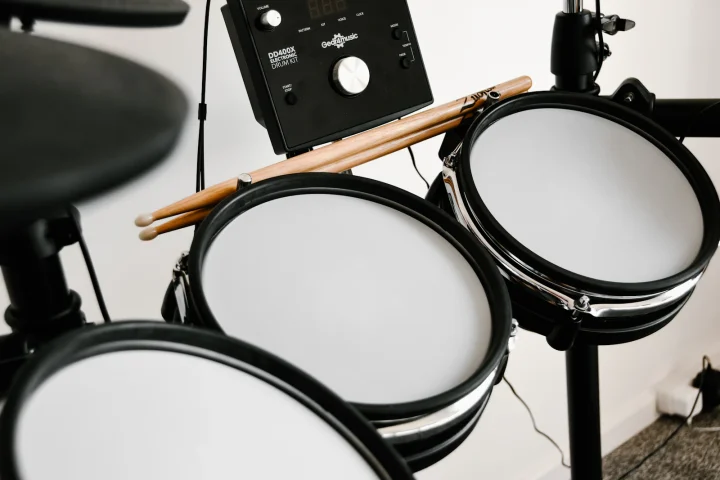
Some congregations find a rack of black pads distracting or out of place. If appearance matters, look at acoustic-style electronic kits, which use full wooden shells and look like real drums from the front. They cost considerably more than rack-mounted kits.
Connecting to the sound system
An electronic kit makes no sound of its own. Plan the whole signal path, not only the kit.
| Part | What it does | What to check |
|---|---|---|
| Module outputs | Send the drum sound to the desk | How many outputs, and what kind of sockets |
| DI boxes | Carry the signal cleanly over a long cable run | Ask your sound team whether they are needed. They usually are |
| Desk channels | Where the engineer sets the level | How many spare channels you have |
| Main speakers | Carry the drums to the room | Whether they can reproduce a bass drum. Small speakers struggle |
| Drummer’s monitor | Lets the drummer hear the kit | Headphones, in-ears or a floor monitor |
| Band monitoring | Lets the other musicians hear the drums | The drums must be in everyone’s monitor mix |
The last two rows catch many churches out. With an acoustic kit, everyone on stage hears the drums without help. With an electronic kit, nobody does unless you send it to them. If the band cannot hear the beat, the timing falls apart.
Speakers matter too. A bass drum needs low frequencies that small speakers cannot produce. If your system was chosen for speech and a piano, electronic drums may sound thin through it. A subwoofer usually fixes that.
How much should a church spend?
On 9 October 2026, the mid-range kits we list below were priced between about six hundred and nine hundred dollars on Amazon.com. Kits from the next range up, built for heavier use, were listed at about seventeen hundred to two thousand dollars. Acoustic-style kits with wooden shells ran from the high two thousands to the mid three thousands. Prices change, so check the live listings.
Whatever the budget, remember the extras: a throne, a bass drum pedal if it is not included, DI boxes, cables and monitoring. For a small congregation, a mid-range kit through a decent PA is a sound choice. A larger church that uses the kit several times a week will get better value from a sturdier, higher-range kit.
Helping drummers adjust
A drummer who has only played acoustic kits may dislike electronic drums at first. A little preparation helps a great deal.
- Give them time alone on the kit before their first service.
- Let them choose and tweak the kit sounds with the sound team.
- Make sure they can hear themselves clearly. Most complaints about feel are really complaints about monitoring.
- Explain why the church made the change. Drummers are far happier when they know the reason is the room, not their playing.
If you would rather keep an acoustic kit
Electronic drums are not the only answer to volume. Some churches keep their acoustic kit and tame it with a clear drum shield, lighter sticks or bundled rods, low-volume cymbals and smaller drums. This keeps the natural feel. It takes a disciplined drummer, and the shield takes up stage space.
Common mistakes to avoid
- Buying the kit without talking to the sound team. They know what the desk and speakers can handle.
- Forgetting monitoring. An electronic kit is silent on stage unless you make it heard.
- Running it through speech-only speakers. The bass drum will sound weak.
- Choosing a pedal-only kick. Acoustic drummers will struggle with it.
- Leaving the module on a factory preset. Spend an hour finding and saving a kit that suits your music.
- Letting everyone change the settings. Agree who looks after the module.
- Expecting it to feel identical to real drums. It will not. Give drummers time to adapt.
Three kits for small and medium churches
Disclosure: the buttons below are affiliate links. If you buy through one of them, we may earn a commission at no extra cost to you.
We chose these from their published specifications. We have not tested them ourselves, and we have not used them in a service. We checked each listing on 9 October 2026. Confirm the outputs against your own sound desk, and check stock and price on the listing before you decide.
Roland TD-07DMK V-Drums Kit
Best for: Small stages and portable churches that need a compact kit.
The listing describes a compact frame, double-ply mesh heads on the snare and tom pads, and a module with deep sound editing, so a team can shape and save a kit that suits the room.
- 8 in mesh snare pad with separate head and rim zones
- Three mesh tom pads with double-ply heads
- TD-07 module with 25 preset kits and 25 user kits
- Bluetooth for playing along, USB for recording
Keep in mind: The listing says the kick pedal, throne and sticks are sold separately. Check the module’s outputs against your desk.
Affiliate link — we may earn a commission.
Alesis Nitro Pro Electric Drum Set
Best for: Churches on a tight budget whose drummers want a real kick pedal feel.
The listing describes an 8-inch mesh kick tower that supports a double pedal, a 10-inch dual-zone snare and a steel rack.
- 10 in dual-zone mesh snare and three 8 in mesh toms
- 8 in mesh kick tower that takes a double pedal
- 10 in hi-hat pad, and ride and crash pads that can be choked
- 36 preset kits, 16 user kits, Bluetooth and USB
Keep in mind: The listing has several bundle options, so check whether a throne is included in the one you choose. Check the module’s outputs against your desk.
Affiliate link — we may earn a commission.
Yamaha DTX6K-X Electronic Drum Set
Best for: Teams that want to adjust the drum sound quickly at soundcheck.
The module has physical knobs for ambience, compression and effects, so the sound can be changed without digging through menus.
- DTX-PRO module with 70 kits and Kit Modifier knobs
- Textured silicone snare head, described as giving realistic rebound
- Cymbal pads that can be choked, and a ride pad with positional sensing
- USB audio and MIDI
Keep in mind: Read the listing to see which pedals are in the box, and budget for a throne. Check the module’s outputs against your desk.
Affiliate link — we may earn a commission.
Thrones, pedals and other extras are covered in our drum accessories guide.
Related reading: our guides to electronic drum sets under 1,000 dollars, electronic vs acoustic drum sets and drum sets for studio recording.
Frequently asked questions
Are electronic drums good for church?
Yes, especially in small or echoing rooms where an acoustic kit is too loud. The sound team controls the level, and the stage stays quiet. The trade-offs are feel, which is close but not identical to real drums, and the need for good monitoring.
What is the best electronic drum set for a small church?
For a small church, a mid-range kit with mesh pads, a kick pad played with a real pedal and a simple module is enough. Match the module’s outputs to your sound desk, and make sure your speakers can carry a bass drum.
How do you connect electronic drums to a church sound system?
Run the module’s outputs to the mixing desk, usually through DI boxes. Most mid-range kits send a stereo mix. Then send the drums to the drummer’s monitor and to the rest of the band, because the kit makes no sound on stage.
Do electronic drums need a drum shield?
No. A shield is used to contain the sound of an acoustic kit. Electronic drums make only a light tapping on stage, so there is nothing to contain.
Will our drummers like playing an electronic kit?
Some take to it at once and some need time. Mesh pads, a real kick pedal and, above all, a clear monitor mix make the biggest difference. Involve your drummers in choosing the kit and its sounds.
Can we use an acoustic kit quietly instead?
Often, yes. A drum shield, lighter sticks or rods, low-volume cymbals and smaller drums all reduce volume. This keeps the natural feel but depends on a disciplined drummer.
Checklist before you buy
- Is volume really the problem we are trying to solve?
- Has the sound team confirmed how many channels are free?
- Do the module’s outputs match the desk?
- Can our speakers reproduce a bass drum?
- How will the drummer hear the kit?
- How will the rest of the band hear the kit?
- Are the pads mesh, and is the kick played with a real pedal?
- Is a pedal included, and do we have a throne?
- Who will look after the module settings?
- Have our drummers tried an electronic kit?
The bottom line
Electronic drums solve one problem very well: volume. In a small or echoing room, they let the band play with energy while the congregation can still hear itself sing. They ask for something in return, which is a sound system and a monitor mix that are up to the job.
Start with your sound team, not with a product page. Find out what the desk and speakers can do, decide how everyone will hear the kit, and then choose a kit with mesh pads and a real kick pedal that fits the budget. Give your drummers time to settle in. To help volunteers practise between services, point them to our free Metronome Trainer and Practice Log.