Best Electronic Drum Sets for Beginners: What to Look For First
A beginner needs mesh pads, a real kick pedal and a metronome, not hundreds of sounds: here is how to choose and set up a first electronic drum set.
PercussionDream is reader-supported. When you buy through links on this page we may earn an affiliate commission, at no extra cost to you. How this works
An electronic drum set is the easiest way for most people to start drumming at home. You can practise on headphones at any hour, the kit takes up little room, and the built-in tools make early practice more fun. The hard part is choosing one, because beginner kits look alike and the listings are full of numbers that do not matter much.
This guide explains what a beginner really needs from an electronic kit, what to ignore, how to set one up on the first day, and how to avoid the common early mistakes. It is written for complete beginners and parents, so you do not need any drum knowledge to follow along.
What a beginner needs, and what can wait
| Feature | How much it matters | Why |
|---|---|---|
| Mesh drum pads | A lot | They feel closer to real drums and are quieter to hit |
| Kick pad with a real pedal | A lot | Your foot learns the proper movement from the start |
| Metronome | A lot | Steady timing is the first skill every drummer needs |
| Headphone output | Essential | It is how you will hear the kit |
| Coaching modes and play-along songs | Useful | They make practice varied and show your progress |
| Bluetooth or audio input | Useful | You can drum along with your own music |
| USB | Useful later | For lesson apps and recording on a computer |
| Hundreds of sounds | Not much | You will use two or three kits most of the time |
| Extra pads and cymbals | Not yet | A standard layout is all you need to learn |
The standard beginner layout
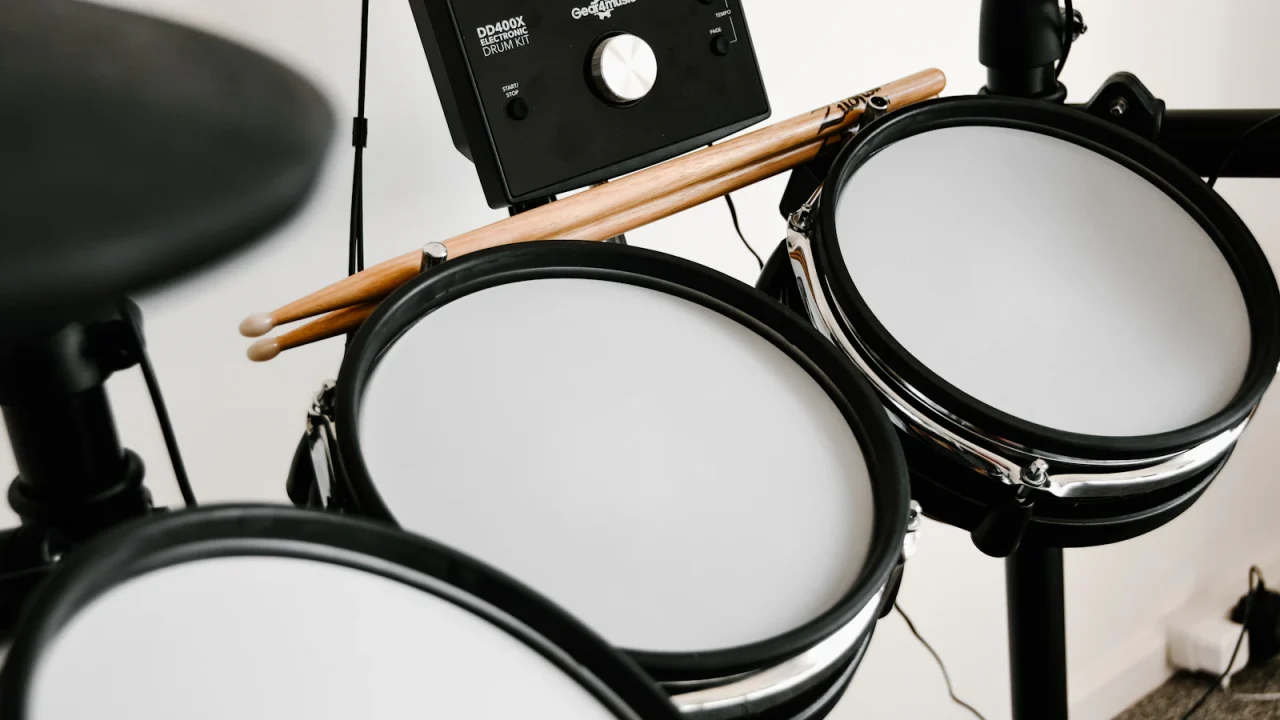
Nearly every beginner electronic kit copies the layout of a 5-piece acoustic drum set. Learn this layout and you can sit down at almost any kit.
- Snare pad, between your knees.
- Three tom pads, two in front and one to the right.
- Kick, under your right foot.
- Hi-hat pad on the left, with its controller under your left foot.
- Crash cymbal pad on the left and ride cymbal pad on the right.
Makers often count the cymbal pads when they describe a kit. That is why a kit with five drum pads and three cymbal pads is sold as an “8-piece”. It is the same layout as a 5-piece acoustic kit.
Features that help you learn
The metronome
A metronome is a steady click that keeps you in time. Almost every module has one. Use it from the first week, at a slow speed, and raise the speed only when a pattern feels easy. This single habit does more for a beginner than any other feature.
Coaching and training modes
Many modules have exercises that test your timing and score the result. They are simple, and they work. One compact kit we checked lists built-in coach functions for guided practice. Another lists ten training functions.
Play-along songs and Bluetooth
Built-in songs with the drum part removed let you play with a band from day one. Bluetooth, or a simple audio input, lets you play along with any music from your phone. Either one turns practice into something you look forward to.
Lesson apps
USB lets the kit talk to a computer, tablet or phone. Several beginner kits come with a trial of an online lesson service. A trial is a good way to get started, but check what it costs once the free period ends.
What is usually not in the box
| Item | Do you need it? | Is it included? |
|---|---|---|
| Throne (drum seat) | Yes. A dining chair is the wrong height | Only with some all-in-one kits |
| Headphones | Yes, or a speaker | Only with some all-in-one kits |
| Sticks | Yes | Often, but not always |
| Bass drum pedal | Yes, if the kit has a kick pad | Usually, but check |
| Rug or mat | Recommended. It stops the kit sliding and softens pedal noise | No |
| Speaker | Only for playing out loud | No |
Add the missing items to the price before you compare two kits. Our drum accessories guide covers thrones, and our drumstick guide explains which size to start with.
Setting up on day one
- Build the rack first, loosely, and tighten everything at the end.
- Set the throne height. Sit with your thighs about level, or sloping down slightly.
- Place the snare pad between your knees, a little above your thighs.
- Set the toms and cymbals so you can reach each one without leaning.
- Put the pedals where your feet rest naturally. Do not twist your legs to reach them.
- Plug each cable into the matching socket. The cables are usually labelled.
- Put the kit on a rug, plug in the headphones and turn the volume down before you switch on.
- Hit every pad to check that each one makes its sound.
Our Setup Visualizer lets you plan the layout on screen, and the Percussion Setup Generator gives you a printable checklist.
If a pad misbehaves
New owners often think a kit is faulty when it only needs adjusting. Two problems are common.
- A pad is too quiet or too loud. The module has a sensitivity setting for each pad. Turn it up or down until normal hits sound normal.
- One hit sets off another pad. This is called crosstalk. Check that the clamps are tight, and look in the manual for the crosstalk setting.
If a pad makes no sound at all, check the cable at both ends before anything else.
Your first few weeks
You do not need long sessions. Fifteen minutes on most days beats an hour once a week.
- Week one: learn to hold the sticks, and play single strokes on the snare with the metronome at a slow speed.
- Week two: add the bass drum and hi-hat, and learn one basic beat.
- Week three: play that beat along with a slow song.
- Week four: add a simple fill round the toms at the end of every fourth bar.
Our Practice Time Calculator turns your free time into a weekly plan, the Rudiment Tracker lists the basic sticking patterns to work through, and the Practice Log helps you keep a streak going.
Will you outgrow a beginner kit?
In time, yes, and that is fine. The first limits most players notice are the size of the pads and the feel of the hi-hat, which on beginner kits is a fixed pad with a separate foot controller. Neither stops you learning. They matter once you start playing with other people or switching to acoustic drums.
A sensible plan is to learn on a beginner kit for a year or two, then decide. By then you will know what you want from the next one.
Common mistakes to avoid
- Choosing by the number of sounds. It tells you nothing about how the kit feels.
- Sitting on a household chair. Poor posture makes everything harder.
- Ignoring the metronome. Timing is the whole job.
- Setting the pads too far apart. Bring everything in close.
- Turning the headphones up loud. Protect your hearing from the start.
- Assuming it is silent. Pedal thumps travel through floors. Use a rug, and warn the neighbours.
- Returning a kit that only needs its sensitivity adjusting. Read the manual first.
Three beginner kits to look at
Disclosure: the buttons below are affiliate links. If you buy through one of them, we may earn a commission at no extra cost to you.
We chose these from their published specifications and from what a learner needs. We have not tested them ourselves. We checked each listing on 9 October 2026. Stock and prices change, so check the listing before you decide.
Alesis Turbo Max Electric Drum Set
Best for: Younger beginners, small rooms and the tightest budgets.
A throne, headphones and sticks are included, so you can play as soon as it is built. It has play-along tracks and exercises in the module.
- Four 8 in mesh drum pads and three 8 in cymbal pads
- Kick and hi-hat pedals, adjustable folding rack
- Throne, over-ear headphones and sticks included
- 12 kits, 20 play-along tracks and Bluetooth
Keep in mind: The bass drum is a pedal-only trigger, not a pad you hit with a real pedal. The pads are small.
Affiliate link — we may earn a commission.
Alesis Nitro Max Electric Drum Set
Best for: Teenagers and adults who want a kit to learn on properly.
It has mesh on every drum pad, a kick tower with a real pedal, Bluetooth for playing along, and the listing includes 90 days of access to an online lesson service.
- 10 in dual-zone mesh snare pad and three 8 in mesh tom pads
- Kick tower with pedal, and 10 in hi-hat, crash and ride pads
- 32 preset kits, Bluetooth and USB
- Folding rack, cables, sticks, drum key and power supply included
Keep in mind: The “drum set only” option does not list a throne or headphones. Check what the lesson service costs after the trial.
Affiliate link — we may earn a commission.
Roland TD-02K V-Drums Kit
Best for: New and returning drummers who want guided practice tools.
The listing describes onboard coach functions for steady skill building, a compact height-adjustable stand, and features to reduce noise at home.
- TD-02 module with 16 ready-to-play kits
- Onboard coach functions
- Height-adjustable stand
- Bluetooth can be added with an optional adaptor
Keep in mind: The listing says the throne and sticks are not included. Check the listing for the exact pads and pedals in the box.
Affiliate link — we may earn a commission.
Not sure whether to start on electronic or acoustic drums? Our guide to the best beginner drum kits compares the two.
Related reading: our guides to electronic drum sets under 1,000 dollars, electronic drum kits for small spaces and electronic vs acoustic drum sets.
Frequently asked questions
Are electronic drums good for beginners?
Yes. They are quiet, compact and come with practice tools such as a metronome and play-along songs. Timing, coordination and basic technique all carry over to acoustic drums.
What should a beginner look for in an electronic drum set?
Mesh pads, a kick pad played with a real pedal, a metronome and a headphone output. Coaching modes and Bluetooth are useful extras. A large sound library is not important.
Do beginner electronic drum sets come with everything?
Some all-in-one kits include a throne, headphones and sticks. Many do not. Read the list of what is in the box, and add the cost of anything missing.
Can you teach yourself drums on an electronic kit?
You can make a good start with the built-in tools, lesson apps and videos. A few lessons with a teacher early on are still worth it, to set your grip and posture.
How long does it take to learn a basic beat?
Most beginners can play a simple beat within the first week or two of short, regular practice. Playing it steadily along with music takes a little longer.
Do I need an amplifier?
No. Headphones are all you need to practise. A speaker is only needed for playing out loud.
Checklist before you buy
- Are the drum pads mesh?
- Is the kick a pad with a real pedal, or a pedal-only trigger?
- Does the module have a metronome and practice tools?
- Is there Bluetooth or an audio input for playing along?
- Are a throne, headphones and sticks included?
- Does the rack adjust to the player’s height?
- Do I have a rug to put under the kit?
- Have I added up the full cost?
- Have I checked today’s price on the live listing?
The bottom line
A beginner does not need an expensive electronic drum set. You need mesh pads that feel right, a kick pad that teaches your foot properly, a metronome and a comfortable seat. Everything beyond that is a bonus.
Choose a kit that covers those basics, check what is in the box, and set it up so that every pad is within easy reach. Then play a little every day with the click on. That routine, not the price of the kit, is what turns a beginner into a drummer.