How Much Does a Percussion Kit Cost? A Comprehensive Guide
A school band percussion kit can cost under a hundred dollars or close to six hundred: here is what each kind includes and whether to rent or buy.
PercussionDream is reader-supported. When you buy through links on this page we may earn an affiliate commission, at no extra cost to you. How this works
When a child joins the school band on percussion, the first letter home usually asks for a “percussion kit”. Parents who expected to buy a pair of drumsticks find themselves looking at a case full of metal bars, a rubber pad and a folding stand, at prices that range from under a hundred dollars to several hundred.
This guide explains what a percussion kit is, what the different kinds cost, why the prices vary so much, and whether to rent or buy. It is written for parents and new students, so you do not need any musical background to follow along.
What is a percussion kit?
In a school band, percussion students do not start on a drum set. They start on two things: a snare drum, or a pad that stands in for one, and a set of bells, which is a small instrument with metal bars laid out like a piano keyboard. The snare teaches rhythm and stick control. The bells teach note reading and melody.
A percussion kit packs what the student needs for one or both of these into a single case. There are three common kinds.
| Kit type | What is usually inside | Price band on 9 October 2026 |
|---|---|---|
| Bell kit, general brand | Bells, a practice pad, a stand, mallets, sticks and a bag | About ninety-five to one hundred and seventy dollars |
| Bell kit, student percussion brand | The same items from a brand that supplies schools | About one hundred and eighty to two hundred and sixty dollars |
| Snare kit, band-instrument maker | A real snare drum, a stand, a practice pad, sticks and a case | About three hundred and fifty dollars |
| Bell kit, band-instrument maker | Bells, pad, stand, mallets and a case, often with wheels or backpack straps | About four hundred and thirty to five hundred and seventy-five dollars |
| Combination kit, band-instrument maker | Bells and a snare drum together, with stand, pad and case | About three hundred and forty to five hundred and ninety dollars |
These bands are rounded from listings we read on Amazon.com and on one distributor’s catalogue on the date shown. They are a snapshot. Prices change, so check the live listing.
The words “percussion kit” are also used loosely for a drum set, and for the boxes of shakers and tambourines used in primary classrooms. This guide is about the school band kit. There is a short note on drum sets further down.
What is inside each kit
Bell kits
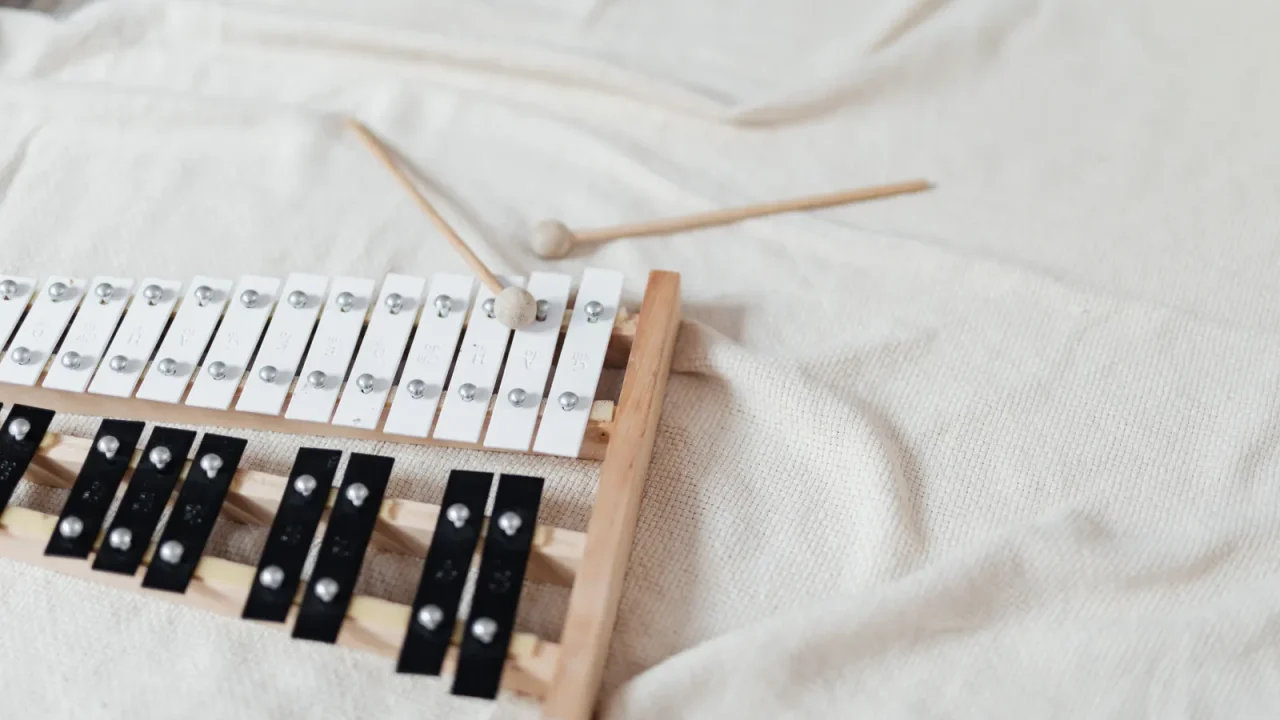
The centre of a bell kit is the set of bells, also called a glockenspiel. Student sets usually have 30 or 32 metal bars covering about two and a half octaves. Many have the note names stamped on the bars.
With the bells you normally get:
- A practice pad, often 8 inches across, for snare drum exercises.
- A folding stand that holds either the bells or the pad.
- A pair of mallets for the bells and a pair of drumsticks for the pad.
- A bag or case, sometimes a backpack or a case with wheels.
Snare kits
A snare kit swaps the bells for a real snare drum, usually 14 inches across, with a stand to hold it. Most include a practice pad that sits on top of the drum or stand, so the student can practise quietly at home and play the real drum at school. Sticks and a case complete the kit.
Combination kits
A combination kit has both the bells and the snare drum. It costs the most and weighs the most. Some programmes ask for one from the start. Others start with bells and a pad and add the snare drum later.
Why do the prices vary so much?
Two bell kits can look almost the same in a photo and differ in price by a factor of five. These are the usual reasons.
- The bars. The bars are the instrument. Better kits use thicker, more carefully tuned bars that sound clearer and more in tune with the rest of the band.
- The stand. A stand that wobbles or sinks is a daily annoyance. Dearer kits have sturdier ones.
- The case. A child carries this to school and back. Wheels, backpack straps and solid zips add cost.
- A real drum. Kits with a snare drum cost more than kits with a pad only.
- The brand. Band-instrument makers sell through school music dealers, and many band directors recommend them by name.
A low-cost bell kit is not automatically a bad buy. The risk is tuning. If the bars are noticeably out of tune, the student will sound wrong in the band however well they play. Ask the band director whether a general-brand kit is acceptable before you order one.
Rent or buy?
| Renting | Buying new | Buying used | |
|---|---|---|---|
| Cost up front | Lowest | Highest | Low to medium |
| If the child gives up | Hand it back | Sell it or keep it | Often resold for close to what you paid |
| Quality | Usually a band-instrument brand approved by the school | Your choice | Depends on what you find |
| Repairs | Often covered by the rental plan | Your responsibility | Your responsibility |
| Best for | The first year, when interest is unproven | Committed students, and families with younger children to follow | Families who know what to check |
Many families rent for the first year and decide after that. Rental terms differ from one shop to another. Ask whether rental payments count towards buying the kit, and what happens if it is damaged.
Buying a used percussion kit
Used kits come up often, because many students stop after a year or two. Check these points:
- Every bar is present and rings clearly. Tap each one.
- The bars are not bent or badly dented.
- The stand opens, locks and holds its height.
- The practice pad is not torn or peeling.
- On a snare drum, both heads are whole, the snare wires underneath are straight, and the lever that switches them on and off works.
- The case zips and its handles are sound.
Missing mallets and sticks are no reason to walk away. They are cheap to replace.
The extras
The kit covers the main items. A few small things are usually needed as well.
- Spare sticks and mallets. They get lost and broken. Our drumstick guide and mallet guide explain the types.
- A metronome. Band directors expect students to practise with one. Our Metronome Trainer is free, and our metronome guide covers stand-alone models.
- A music stand for home practice.
- The method book the band uses.
- Hearing protection for rehearsals. See our guide to earplugs for musicians.
Our guides to school percussion kits and concert percussion go into more detail on what students are asked to bring.
If you meant a drum set
Some people say “percussion kit” when they mean a drum set, the full kit with a bass drum, toms and cymbals. That is a different purchase at a different price. On 9 October 2026, complete beginner drum sets from well-known drum makers were listed on Amazon.com at around seven hundred dollars, and no-name full-size starter sets at about two hundred to under four hundred dollars. Our guide to the best beginner drum kits explains what those include.
A school band student does not need a drum set to begin. The band kit comes first.
Common mistakes to avoid
- Buying before you have the band’s list. Requirements differ from school to school.
- Buying a drum set for a band beginner. It is not what the lessons use.
- Choosing on price alone. Out-of-tune bells cannot be fixed.
- Forgetting who carries it. A heavy kit with no wheels is hard work for a small child.
- Skipping the practice pad. It is what makes home practice bearable for everyone else.
- Not labelling the case. School band rooms are full of identical kits.
- Ignoring rental. It is often the cheapest way through the first year.
Two kits to look at
Disclosure: the buttons below are affiliate links. If you buy through one of them, we may earn a commission at no extra cost to you.
Here is one bell kit and one snare kit. We chose them from their published specifications. We have not tested them ourselves, and we have not checked the tuning of the bells. Confirm with your band director that the kit meets the school’s requirements. We checked each listing on 9 October 2026. Stock and prices change, so check the listing before you decide.
Eastar Advanced 32-Note Glockenspiel Bell Kit
Best for: Families who need a complete bell kit at a lower cost, where the school accepts general-brand kits.
The listing shows a 32-note set of aluminium bells with the note names marked, a tunable practice pad, a stand and a backpack-style bag.
- 32 aluminium bars, with each note marked
- 8 in tunable practice pad
- Adjustable stand, listed as reaching 35.5 in
- Mallets, drumsticks and carrying bag included
Keep in mind: We have not checked how accurately the bars are tuned. Ask the band director whether this type of kit is acceptable, and check each note when it arrives.
Affiliate link — we may earn a commission.
Pearl SK910C Educational Snare Kit with Rolling Case
Best for: Students whose band programme asks for a snare drum kit.
It is a snare kit from an established drum maker, with a real steel snare drum, a practice pad and a case with wheels.
- 14 x 5.5 in steel snare drum
- 14 in practice pad
- Heavy-duty snare stand
- 5A sticks and rolling case included
Keep in mind: It has no bells. If the school asks for a bell kit or a combination kit, this is not enough on its own.
Affiliate link — we may earn a commission.
Related reading: our guides to how much drum sets cost and drums vs percussion and how they differ.
Frequently asked questions
How much does a percussion kit cost?
On 9 October 2026, bell kits from general brands were listed on Amazon.com at about ninety-five to one hundred and seventy dollars. Snare kits from band-instrument makers were about three hundred and fifty dollars, and bell and combination kits from those makers ran up to about five hundred and ninety dollars. Check current listings, because prices change.
What is in a percussion kit?
A bell kit has a set of bells, a practice pad, a stand, mallets, sticks and a case. A snare kit has a snare drum, a stand, a pad, sticks and a case. A combination kit has both.
Should I rent or buy a percussion kit?
Renting makes sense for the first year, when you do not yet know whether the interest will last. Buying makes sense for a committed student, or when younger brothers or sisters may use the kit later.
Is a cheap bell kit good enough for school band?
It can be, if the bars are in tune and the school accepts it. Ask the band director first. Poorly tuned bells are the main risk with low-cost kits, and they cannot be corrected.
Does a band student need a drum set?
No. Beginning band percussion is taught on snare drum and bells. A drum set is a separate instrument that some students take up later.
What is the difference between a bell kit and a xylophone?
Bells, also called a glockenspiel, have metal bars and a bright, ringing sound. A xylophone has wooden or synthetic bars and a shorter, drier sound. Student kits use bells because they are small and light.
Checklist before you buy
- Which kit does the band director ask for: bell, snare or combination?
- Does the school accept general-brand kits?
- Is renting available, and on what terms?
- How many notes do the bells have?
- Is a practice pad included?
- Does the stand feel solid and adjust to the student’s height?
- Can the student carry or wheel the case?
- Are mallets and sticks included?
- Have I checked today’s price on the live listing?
The bottom line
A percussion kit can cost under a hundred dollars or close to six hundred. The difference comes down to the kind of kit, the quality of the bells and the name on the case. Before you spend anything, find out exactly what the band programme requires and whether renting is an option.
If you buy, put tuning and a sturdy stand ahead of extras, and choose a case the student can manage alone. Then help them build a short daily practice habit. Our Practice Time Calculator and Practice Log make that easier to keep up.
You may also like
Best Drum Kit for Jazz: A Beginner’s Guide
Buying Steel Tongue Drums and Steelpans: A Full Guide