Best Drum Sets for Studio Recording: What Matters and What to Buy
Tuning, heads and the room shape a drum recording more than the price of the kit: here is what to look for in a drum set you plan to record.
PercussionDream is reader-supported. When you buy through links on this page we may earn an affiliate commission, at no extra cost to you. How this works
Ask ten engineers which drum set records best and you will get ten answers. Ask them what makes drums sound good on a recording, and they will mostly agree: the player, the tuning, the heads and the room come first. The badge on the bass drum comes a long way down the list.
This guide explains what really shapes a recorded drum sound, what to look for in a kit you plan to record, and how to record at home without a studio. It is written for drummers and home recordists, so you do not need engineering knowledge to follow along.
What shapes a recorded drum sound
This is the order most engineers would put things in. It is general studio wisdom, not a measurement, but it is a useful guide to where your money and effort should go.
| Factor | Why it matters | Cost to improve |
|---|---|---|
| The player | Even, controlled hitting makes any kit sound better | Practice |
| Tuning | A badly tuned drum sounds bad through any microphone | Free, once you learn how |
| Drum heads | Old, dented heads sound dull and are hard to tune | Low |
| The room | Microphones record the room as well as the drums | From free to very high |
| Cymbals | Harsh cymbals are hard to fix after recording | Medium to high |
| Microphones and where they are placed | Placement changes the sound more than the model does | Medium |
| The shells | They set the basic character of the kit | Medium to high |
The lesson is not that the kit does not matter. It is that a mid-range kit, set up well, will out-record a top-of-the-range kit with old heads in a boxy room.
What to look for in a kit for recording
Shell wood
Birch and maple are the two woods most often recommended for recording. By long convention, birch is described as punchy and focused, with strong highs and lows. Maple is described as warm and even. Both record well. The difference is one of flavour, and tuning and heads can move either a long way.
Poplar, the usual wood in beginner kits, can be recorded too. If that is what you own, new heads and careful tuning are a better investment than a new kit.
Tom mounts
Look for suspension mounts, which hold a tom by its hoop or lugs and not through a hole in the shell. The drum can ring more freely. Mid-range shell packs often include them.
Sizes
Moderate sizes are the easiest to record. A 20 or 22-inch bass drum, 10 and 12-inch rack toms and a 14 or 16-inch floor tom cover most music. Very large drums ring for longer and take more work to control. Very small ones can sound thin outside jazz.
The snare
The snare is the most heard drum on almost every recording, and the one players most often choose separately. A shell pack may or may not include one. If it does, treat it as a starting point. Our snare drum guide explains sizes and shell materials.
Hardware that stays quiet
Microphones hear everything. A squeaky pedal, a rattling lug or a loose wing nut ends up on the track. Any decent hardware will do, as long as it is tight and oiled.
Versatility
If one kit has to cover recording, rehearsals and gigs, choose standard sizes and a wood you like, and change the sound with heads and tuning. A versatile kit is simply one that tunes well across a wide range.
Shell packs: what you still need
Kits aimed at recording and gigging are nearly always sold as shell packs. That means drums only. Read the listing closely. One birch shell pack we checked states plainly that no cymbals, stands, kick pedal or throne are included.
To finish a shell pack you will need:
- Cymbals: hi-hats, a ride and at least one crash.
- Stands for the snare, hi-hat and cymbals.
- A bass drum pedal and a throne.
- Possibly a snare drum, if the pack does not include one.
If you are moving up from a beginner kit, you can reuse your stands, pedal and throne. That makes a shell pack a sensible upgrade path.
Three ways to record drums at home
| Route | What you need | Noise | Result |
|---|---|---|---|
| Acoustic kit with microphones | Microphones, stands, cables, an audio interface and a room that sounds decent | Very loud | The real sound of your kit and room, good or bad |
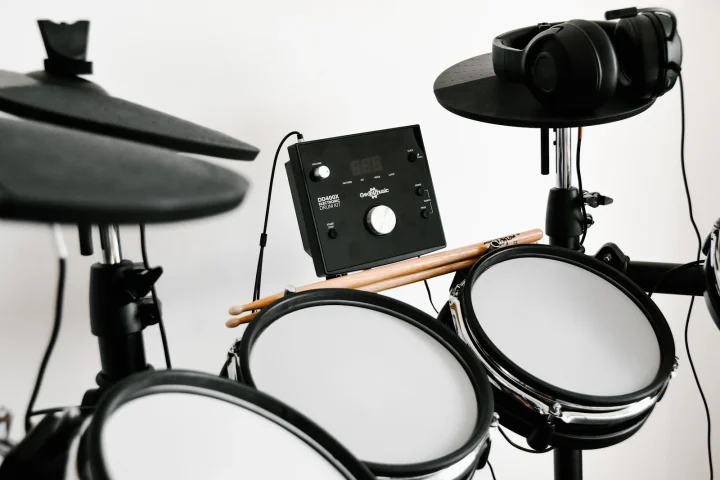
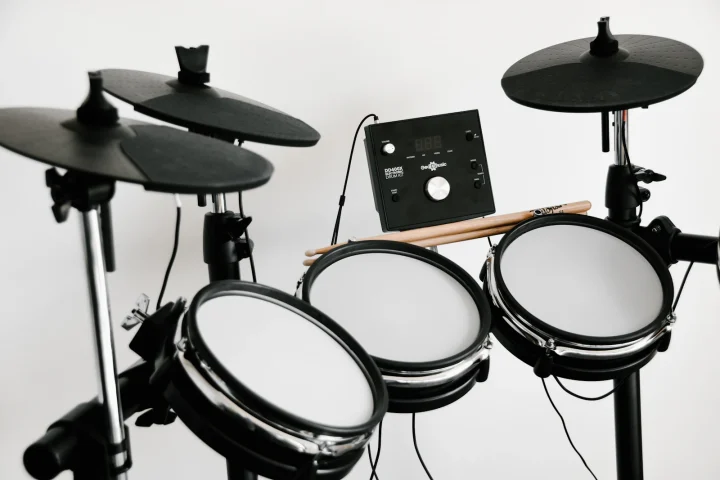
| Electronic kit by USB | An electronic kit, a USB cable and recording software | Quiet | Clean and consistent. You can change the drum sounds after recording |
| Acoustic kit with triggers | Triggers on the drums, a module or software, and usually microphones for the cymbals | Very loud | Real playing feel with replaced or blended drum sounds |
For many home recordists, the electronic route is the practical one. There is no room sound to fight, no neighbours to upset and no microphones to buy. The trade-off is feel, and cymbals that sound less natural than the real thing.
How many microphones do you need?
Fewer than you might think. Engineers have made excellent drum recordings with very simple setups.
- One or two microphones above or in front of the kit capture the whole instrument as one sound. This is the cheapest way to start, and it rewards good tuning and balanced playing.
- Four microphones is a common next step: one on the bass drum, one on the snare and two overhead.
- A microphone on every drum gives the most control at the mixing stage and needs the most gear and skill.
Start small. Moving one microphone a few inches changes the sound more than buying a second one.
Getting a kit ready to record
- Fit new heads, at least on the snare and toms, and give them a day to settle.
- Tune carefully. Tap near each lug and even out the pitch. Tune the toms so they step down clearly from high to low.
- Control the ring. A little ring sounds good on a recording. Too much blurs the notes. Small stick-on damping pads let you adjust it.
- Hunt for noises. Tighten every wing nut, oil the pedals and check for rattles by hitting each drum on its own.
- Sort out the bass drum. A small pillow or blanket inside, touching the head lightly, shortens the note.
- Make a test recording. Listen back before you play a full take. Fix problems at the kit, not afterwards.
Our Maintenance Tracker can remind you when heads are due for a change.
What recording kits cost
On 9 October 2026, popular birch and maple shell packs on Amazon.com were listed from about eight hundred and fifty to thirteen hundred dollars. Professional shell packs from the main makers were mostly between about eighteen hundred and three thousand dollars. These are drums only. Prices change, so check the live listing.
Remember where the sound comes from. If your budget is fixed, a mid-range shell pack with good heads and better cymbals will usually give you a stronger recording than a professional shell pack with whatever cymbals are left over.
Common mistakes to avoid
- Buying a dearer kit to fix a tuning problem. Learn to tune first.
- Recording on old heads. Fresh heads are the cheapest upgrade there is.
- Ignoring the room. A small, bare room adds a harsh, boxy sound. Rugs, curtains and soft furniture help.
- Forgetting that shell packs are drums only.
- Using too many microphones too soon. More microphones mean more ways to get it wrong.
- Hitting the cymbals too hard. They are the loudest part of a kit on a recording. Play the drums firmly and the cymbals lightly.
- Recording without hearing protection. Closed headphones or earplugs are essential. See our guide to earplugs for musicians.
Three kits to look at
Disclosure: the buttons below are affiliate links. If you buy through one of them, we may earn a commission at no extra cost to you.
Here are two shell packs and one electronic kit. We chose them from their published specifications. We have not tested or recorded them ourselves. We checked each listing on 9 October 2026. Stock was limited on the shell packs, so check the listing before you decide.
Yamaha Stage Custom Birch 5-Piece Shell Pack, 22 in Kick
Best for: Drummers moving up from a beginner kit who want all-birch shells.
It is a 100 percent birch kit in standard sizes with a matching snare. Yamaha’s own description says it is at home on a gig, in the studio or in a teaching room.
- 22 x 17 in kick, 14 x 5.5 in snare
- 10 x 7 in and 12 x 8 in rack toms, 16 x 15 in floor tom
- 100 percent birch shells with 45-degree bearing edges
- Tom mounts and floor tom legs included
Keep in mind: The listing states that no cymbals, stands, kick pedal or throne are included. A 20-inch kick version is sold as a separate option.
Affiliate link — we may earn a commission.
PDP Concept Maple 5-Piece Shell Pack
Best for: Players who want maple shells and suspension tom mounts.
The listing shows 7-ply European maple toms and kick, a 10-ply maple snare, and suspension mounts that let the toms ring freely.
- 18 x 22 in bass drum, 5.5 x 14 in snare
- 8 x 10 in and 9 x 12 in toms, 14 x 16 in floor tom
- European maple shells
- Suspension tom mounts and Remo heads
Keep in mind: It is a shell pack, so cymbals and stands are extra. Only a couple were in stock in each finish when we checked.
Affiliate link — we may earn a commission.
Alesis Nitro Max Electric Drum Set
Best for: Recording at home with no microphones and no noise.
The listing says it connects to a computer by USB for recording into music software, and that you can add further drum sounds on the computer.
- 10 in dual-zone mesh snare pad and three 8 in mesh tom pads
- Kick tower with pedal, and 10 in hi-hat, crash and ride pads
- USB and MIDI connection to a computer
- 32 preset kits and more than 440 sounds
Keep in mind: It is an entry-level kit. The pads are small and the hi-hat is a fixed pad with a foot controller. The “drum set only” option does not list a throne or headphones.
Affiliate link — we may earn a commission.
If you are still on your first kit, our guide to the best beginner drum kits covers complete kits, and our drum accessories guide covers thrones, tuning tools and sound control.
Related reading: our guides to 4-piece vs 5-piece drum sets, how much drum sets cost and electronic vs acoustic drum sets.
Frequently asked questions
What is the best drum set for recording?
There is no single best kit. A mid-range birch or maple kit with fresh heads and careful tuning will record well. Tuning, heads, the room and the player make more difference than the price of the drums.
Is birch or maple better for recording?
Both are widely used. Birch is usually described as punchy and focused, and maple as warm and even. Choose the one you like the sound of. Heads and tuning can shift either a long way.
Can you record a beginner drum set?
Yes. Fit new heads, tune it well, remove any rattles and consider better cymbals. Those steps improve a recording more than replacing the drums.
Do I need an expensive kit for a professional sound?
No. Professional kits offer finer build and finish, but a well-prepared mid-range kit in a decent room can sound professional on a recording.
Can I record drums without microphones?
Yes, with an electronic kit. Most connect to a computer by USB, so you can record what you play and choose or change the drum sounds in software.
How many microphones do I need to record drums?
You can start with one or two. A common four-microphone setup uses one on the bass drum, one on the snare and two overhead. More microphones give more control but need more skill.
Checklist before you buy
- Have I fitted new heads and learned to tune my current kit?
- Is the kit I am looking at a shell pack or a complete kit?
- Is a snare drum included?
- Do I already own stands, a pedal, a throne and cymbals?
- Are the sizes moderate and easy to control?
- Can I make noise where I plan to record?
- Do I have microphones and an interface, or would USB from an electronic kit be simpler?
- Have I thought about the room: rugs, curtains, soft furniture?
- Have I checked today’s price and stock on the live listing?
The bottom line
A great drum recording starts long before the microphones go up. It starts with a drummer who plays evenly, a kit that is tuned with care, heads that are fresh and a room that is not working against you. Get those right and a mid-range kit will sound far better than its price suggests.
When you do buy, choose birch or maple in moderate sizes, expect to add cymbals and hardware to a shell pack, and spend what is left on heads and cymbals. If noise or space rules out an acoustic kit, record an electronic one by USB and do not apologise for it. To build the control that makes any kit record well, our Metronome Trainer and Practice Log are free to use.